
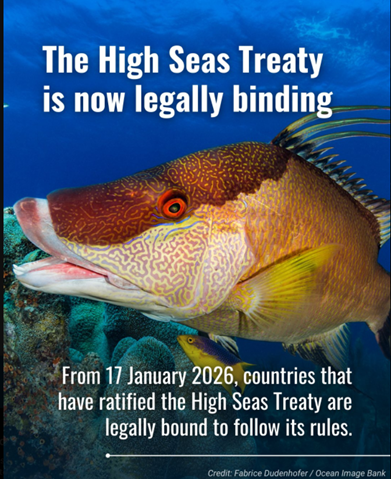
The new year, 2026, has started on a very positive and exciting note! On January 17th, the High Seas Treaty officially entered into force. This follows two decades of discussions and negotiations plus 60 ratifications. It has now officially become international law and marks a significant historical milestone for global ocean protection and multilateral cooperation. (For more information see August and September 2025 blog entry)
The High Seas form part of the global commons, as they lie outside national jurisdiction and cover two-thirds, or nearly half, of our oceans. This legal framework, established by the UN Treaty, supports a new era of ocean governance and cooperation for a more resilient ocean and economy. This Treaty, formerly the Biodiversity Beyond National Jurisdiction – BBNJ, will now protect biodiversity in international waters. It ensures that the benefits of their resources are shared fairly among all nations. This will help achieve global biodiversity and climate goals. It also aims for the important global target to protect 30% of the ocean by 2030 (30×30).
The High Seas Treaty now provides the necessary tools for the following:
- Create marine protected areas (MPAs) on the High Seas,
- Set clear obligations on how to ensure ocean resources are used sustainably.
- Prioritize capacity building and access to technology and tools.
- Establish mechanisms to ensure fair benefit-sharing
See Video Celebrating the Entry into Force of the High Seas Treaty
More information regarding the High Seas Treaty can be found in July 2025 on this blog and on the High Seas Alliance & WWF websites.
Oceanic Sharks in Danger
In 2021, researchers found that oceanic shark populations in the high seas have fallen by 71% since 1979. The main cause is Illegal, Unreported and Unregulated (IUU) fishing, combined with new, larger boats and more advanced fishing gear. The sharks’ slow rate of reproductive maturity and few births also make them more vulnerable to depletion. (see Science.org article)
Studies also show a severe regional decline in specific species, such as the scalloped hammerhead (Sphyrna lewini) shark, in the Atlantic. Costa Rica banned the fishing of hammerhead sharks yet they continue to be bought and sold, and transit from Nicaragua authorized, due to the high demand of shark fin soup in Asian markets. (see Mongabay 2023)
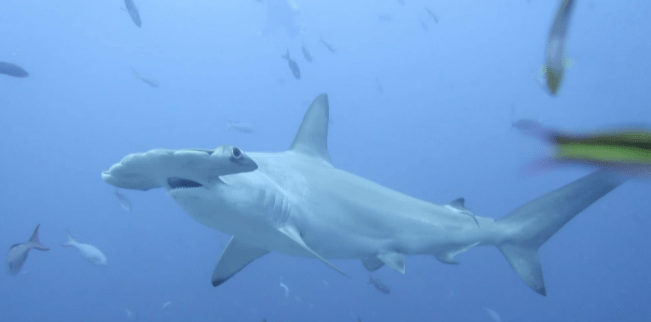
Photo: Galapagos.org
A new Satellite-tracking study (Nova Southeastern University-NSU) has also shown that the nomadic Silky shark (Carcharhinus falciformis) migrates long distances and is greatly impacted by commercial fishing and is a victim of the international shark fin trade. The Silky shark’s population has seen a 47 to 54 percent decline in the past 30-40 years. It is now listed on the IUCN Red List of Threatened Species as both vulnerable and at high risk of extinction.
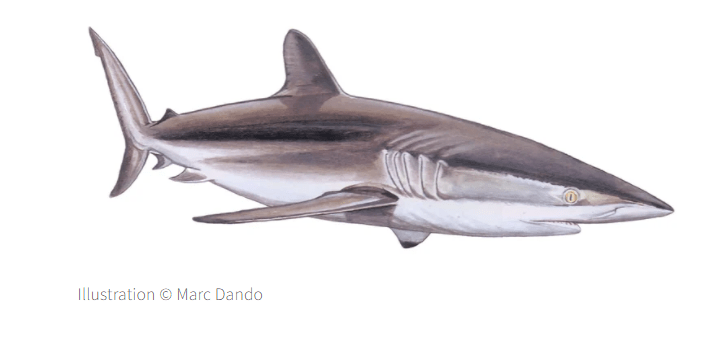
Source: sharks.org
The application of the new High Seas Treaty, along with fishing regulations, shark awareness, and marine education in schools and the public, is more urgent than ever.
CLASSROOM IDEAS/RESOURCES
- Teach your students about the importance of our ocean. Explain why the open oceans are significant. Highlight the new Treaty’s role in protecting biodiversity in international waters, including sharks. See Ocean Generation’s fact sheet “What is the HighSeas Treaty?”
- The High Seas Educators Guide. Produced by WWF-UK this also provides videos, links to Sustainable Development Goal #14 (SDG) and several discussion prompts. In addition to several excellent interdisciplinary activities listed under the Extension Activity Ideas.
- For the start of a new year (and second school semester), why not plan your lessons around ocean events? Consider incorporating environmental events as well. The Ocean Life Education in Australia has printed an exciting 2026 Ocean and Environment Events Calendar. You can use and update it for your country/region. Don´t forget June 8th, is World Ocean Day.

 Teachers4Sharks