
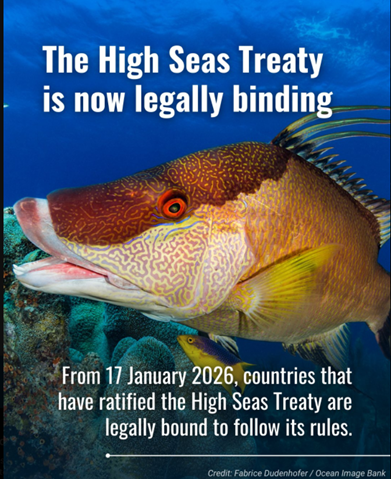
The new year, 2026, has started on a very positive and exciting note! On January 17th, the High Seas Treaty officially entered into force. This follows two decades of discussions and negotiations plus 60 ratifications. It has now officially become international law and marks a significant historical milestone for global ocean protection and multilateral cooperation. (For more information see August and September 2025 blog entry)
The High Seas form part of the global commons, as they lie outside national jurisdiction and cover two-thirds, or nearly half, of our oceans. This legal framework, established by the UN Treaty, supports a new era of ocean governance and cooperation for a more resilient ocean and economy. This Treaty, formerly the Biodiversity Beyond National Jurisdiction – BBNJ, will now protect biodiversity in international waters. It ensures that the benefits of their resources are shared fairly among all nations. This will help achieve global biodiversity and climate goals. It also aims for the important global target to protect 30% of the ocean by 2030 (30×30).
The High Seas Treaty now provides the necessary tools for the following:
- Create marine protected areas (MPAs) on the High Seas,
- Set clear obligations on how to ensure ocean resources are used sustainably.
- Prioritize capacity building and access to technology and tools.
- Establish mechanisms to ensure fair benefit-sharing
See Video Celebrating the Entry into Force of the High Seas Treaty
More information regarding the High Seas Treaty can be found in July 2025 on this blog and on the High Seas Alliance & WWF websites.
Oceanic Sharks in Danger
In 2021, researchers found that oceanic shark populations in the high seas have fallen by 71% since 1979. The main cause is Illegal, Unreported and Unregulated (IUU) fishing, combined with new, larger boats and more advanced fishing gear. The sharks’ slow rate of reproductive maturity and few births also make them more vulnerable to depletion. (see Science.org article)
Studies also show a severe regional decline in specific species, such as the scalloped hammerhead (Sphyrna lewini) shark, in the Atlantic. Costa Rica banned the fishing of hammerhead sharks yet they continue to be bought and sold, and transit from Nicaragua authorized, due to the high demand of shark fin soup in Asian markets. (see Mongabay 2023)
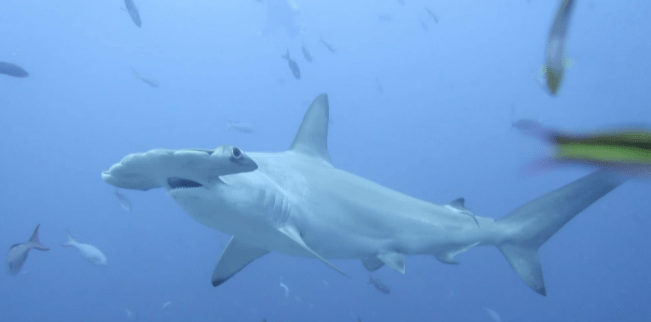
Photo: Galapagos.org
A new Satellite-tracking study (Nova Southeastern University-NSU) has also shown that the nomadic Silky shark (Carcharhinus falciformis) migrates long distances and is greatly impacted by commercial fishing and is a victim of the international shark fin trade. The Silky shark’s population has seen a 47 to 54 percent decline in the past 30-40 years. It is now listed on the IUCN Red List of Threatened Species as both vulnerable and at high risk of extinction.
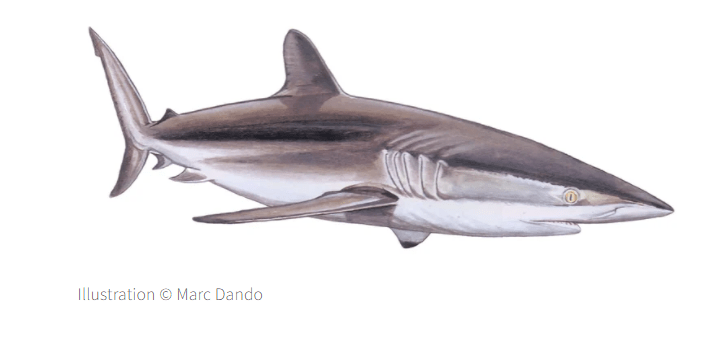
Source: sharks.org
The application of the new High Seas Treaty, along with fishing regulations, shark awareness, and marine education in schools and the public, is more urgent than ever.
CLASSROOM IDEAS/RESOURCES
- Teach your students about the importance of our ocean. Explain why the open oceans are significant. Highlight the new Treaty’s role in protecting biodiversity in international waters, including sharks. See Ocean Generation’s fact sheet “What is the HighSeas Treaty?”
- The High Seas Educators Guide. Produced by WWF-UK this also provides videos, links to Sustainable Development Goal #14 (SDG) and several discussion prompts. In addition to several excellent interdisciplinary activities listed under the Extension Activity Ideas.
- For the start of a new year (and second school semester), why not plan your lessons around ocean events? Consider incorporating environmental events as well. The Ocean Life Education in Australia has printed an exciting 2026 Ocean and Environment Events Calendar. You can use and update it for your country/region. Don´t forget June 8th, is World Ocean Day.
Tratado do Mar Alto: Uma Nova Era para a Proteção do Oceano
O novo ano, 2026, começou de maneira muito positiva e emocionante! Em 17 de janeiro, o Tratado sobre Alta Mar entrou oficialmente em vigor. Isso segue duas décadas de discussões e negociações, além de 60 ratificações. Agora, ele se torna oficialmente uma lei internacional e marca um marco histórico significativo para proteção global dos oceanos e cooperação multilateral. (Para mais informações, veja a entrada do blog de agosto e setembro de 2025)
O Mar Alto faz parte dos bens comuns globais, uma vez que estão fora da jurisdição nacional e cobrem dois terços, ou quase metade, dos nossos oceanos. Este marco legal, estabelecido pelo Tratado da ONU, apoia uma nova era de governança e cooperação oceânica para um oceano e uma economia mais resilientes. Este Tratado, anteriormente conhecido como Biodiversidade Além da Jurisdição Nacional – BBNJ, agora protege a biodiversidade em águas internacionais. Ele garante que os benefícios de seus recursos sejam compartilhados de forma justa entre todas as nações. Isso ajudará a alcançar as metas globais de biodiversidade e clima. Também visa o importante objetivo global de proteger 30% do oceano até 2030 (30×30).
O Tratado do Mar Alto agora fornece as ferramentas necessárias para o seguinte:
- Criar áreas marinhas protegidas (AMPs) em alto-mar,
- Estabelecer obrigações claras sobre como garantir que os recursos oceânicos sejam utilizados de forma sustentável.
- Priorizar a capacitação e o acesso a tecnologias e ferramentas.
- Estabelecer mecanismos para garantir uma distribuição justa dos benefícios
See Video Celebrating the Entry into Force of the High Seas Treaty
Em 2021, pesquisadores descobriram que as populações de tubarões oceânicos em alto-mar caíram 71% desde 1979. A principal causa é a pesca Ilegal, Não Declarada e Não Regulamentada (IUU), combinada com barcos novos, maiores e equipamentos de pesca mais avançados. A lenta taxa de maturidade reprodutiva dos tubarões e o pequeno número de nascimentos também os tornam mais vulneráveis à depleção. (veja artigo do Science.org)
Estudos também mostram um grave declínio regional em espécies específicas, como o tubarão martelo escamado (Sphyrna lewini), no Atlântico. A Costa Rica proibiu a pesca de tubarões martelo, mas eles continuam a ser comprados e vendidos, e seu trânsito da Nicarágua é autorizado, devido à alta demanda por sopa de barbatana de tubarão nos mercados asiáticos. (veja Mongabay 2023)
Um novo estudo de rastreamento de satélites (Universidade Nova da Flórida-NSU) também mostrou que o tubarão sedoso (Carcharhinus falciformis) migra longas distâncias e é amplamente impactado pela pesca comercial, além de ser vítima do comércio internacional de barbatana de tubarão. A população de tubarões sedosos viu uma queda de 47 a 54 por cento nos últimos 30-40 anos. Agora, está listada na Lista Vermelha da IUCN de Espécies Ameaçadas como vulnerável e em alto risco de extinção.
A aplicação do novo Tratado sobre Altamar, junto com as regulamentações de pesca, conscientização sobre tubarões e educação marinha nas escolas e no público, é mais urgente do que nunca.
IDEIAS/RECURSOS DE SALA DE AULA
- Ensine seus alunos sobre a importância do nosso oceano. Explique por que os oceanos abertos são significativos. Destaque o papel do novo Tratado na proteção da biodiversidade nas águas internacionais, incluindo tubarões. Veja a folha informativa da Ocean Generation “O que é o Tratado de Alto Mar?”
- O Guia de Educadores dos Mares Altos. Produzido pela WWF-UK, também fornece vídeos, links para o Objetivo de Desenvolvimento Sustentável #14 (ODS) e várias perguntas de discussão. Além disso, contém várias atividades interdisciplinares excelentes listadas sob as Ideias de Atividades de Extensão.
- Para o início de um novo ano (e segundo semestre escolar), que tal planejar suas aulas em torno de eventos oceânicos? Considere incorporar eventos ambientais também. A Ocean Life Education na Austrália publicou um emocionante Calendário de Eventos Oceânicos e Ambientais 2026. Você pode usá-lo e atualizá-lo para seu país/região. Não se esqueça que 8 de junho é o Dia Mundial dos Oceanos.


You must be logged in to post a comment.