
Blog Entry Delayed due to Natural Disaster!
The phrase “better late than never” is the most appropriate way to begin this delayed blog entry. Whilst both February and March are long gone, here in southern Europe, they were marked by unusual extreme weather patterns. These patterns caused much damage to our natural and built environment. This includes my small town (Cascais) on the coast of Portugal facing the mighty Atlantic Ocean. Although no lives were at stake, the extensive damage to century old trees, houses, and cars was devastating. Even old sturdy walls suffered destruction both on the coast and in the Sintra mountains nearby. I helped family, friends, and neighbors assess the damage and I sympathized with everyone who experienced damage. Some encountered even worse scenarios.
The Mysterious Megalodon- an Ancient Shark
“The Megadolon or Carcharocles megalodon was once the most fearsome predator to reign the seas. This ancient shark lived roughly 23 to 3. 6 million years ago in nearly every corner of the ocean. Roughly up to 3 times the length of a modern-day great white shark, it is the largest shark to have ever lived,” (Source: Smithsonian Ocean – Find your Blue)
For more information and lesson plans, please visit Smithsonian Ocean and their Educators Corner.
See Video about Megalodon teeth The Natural History Museum – London
Latest News! Update on Megalodon’s True Form
An exciting new paper was published in Paleontologia Electronica on March 9, 2025. It explains how Megalodon may have been even longer and narrower than estimated before. This is compared to what they first proposed in an earlier study published in January 2024. This enormous extinct shark, scientists now say, grew to between 54 (16.4 m) to 80 (24.3 m) feet long. Researchers from the University of California at Riverside suggest that the extinct Megalodon looked less like a white shark. They now believe it resembled more like an elongated lemon shark. The Smithsonian Magazine also explains how this research provides a framework for how size influenced movements in marine mammals. Megalodons probably also swam at more moderate speeds to preserve their energy. They only swam in fast spurts and quickly in order to catch their prey.
Sharks’ bones are made of cartilage and do not preserve well. However, incomplete fossils of the vertebral column have been found and assisted scientists with their new theory. The Megalodon’s teeth have also been found and are well preserved, allowing for further clues.
The graphic below shows a comparison of the size of a Megalodon and a human. This is based on new research. The study estimates that the extinct sharks grew to 24.3 meters or 80 feet long. However, most fins’ exact shape, size, and position remain unknown. Kenshu Shimada / DePaul University
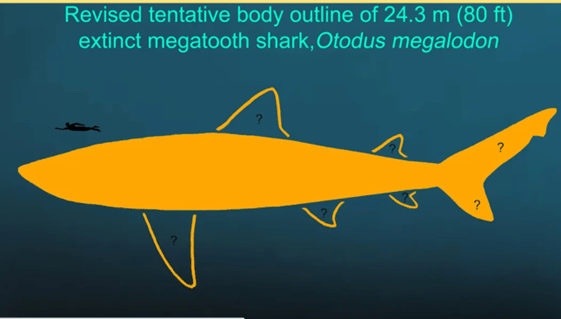
NOTE: An adult human (Homo sapiens) is depicted for size comparison, but it must be emphasized that the two species never coexisted.
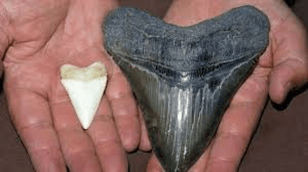
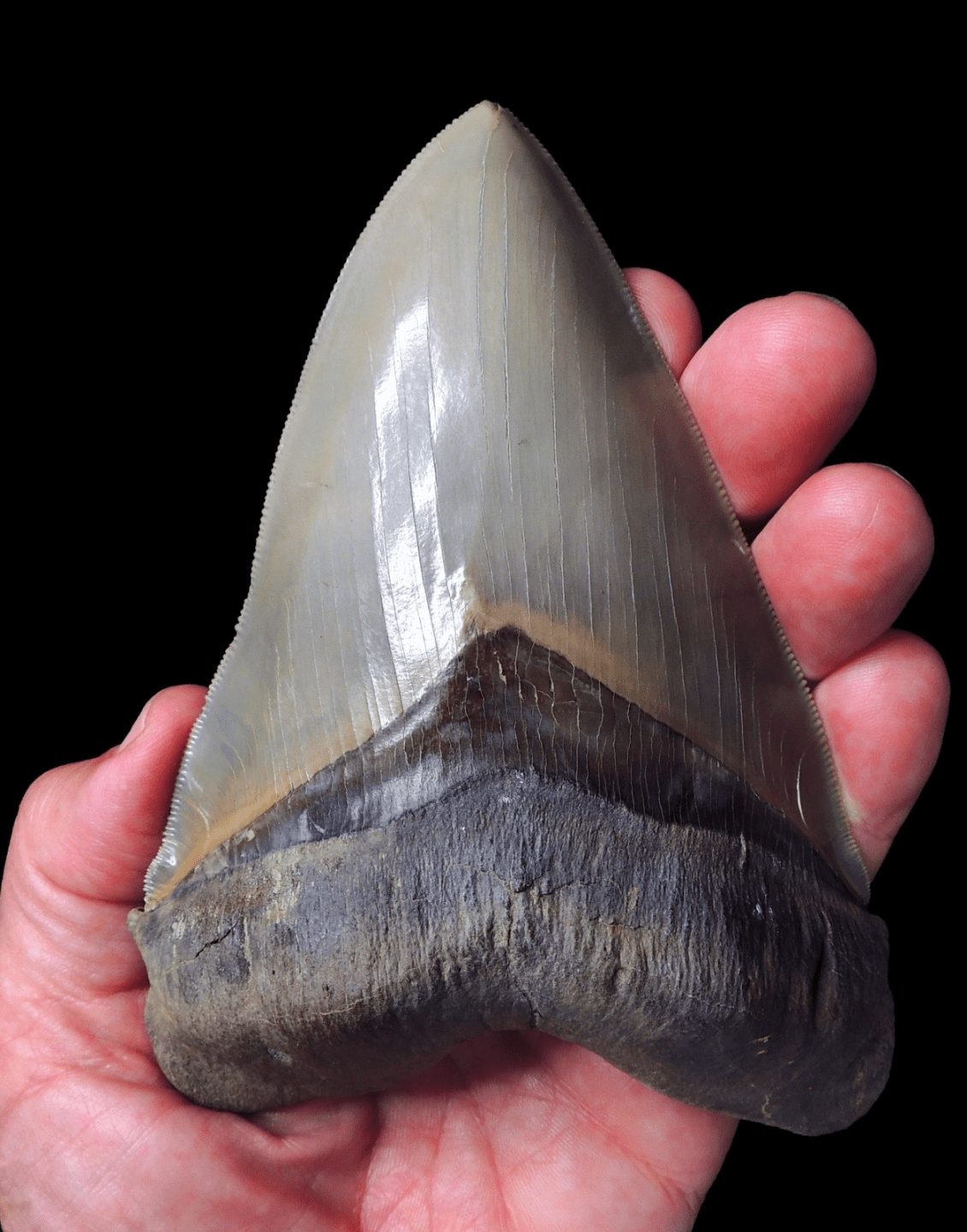
A great white shark tooth compared with that of a Megalodon fossilized tooth.
3D view of Megalodon tooth fossil (Click to load image)
Shark Movies – The Meg
Both The Meg and its sequel, Meg 2: The Trench, are popular fictional movies depicting the extinct Megalodon shark. Why not use these movies as stepping stones to further investigate this gigantic prehistoric shark with your class? Also address the importance of and need for shark conservation. Join Sharks Educational Institute – SEI Portugal. Learn more about sharks and how we can protect them.
Listen to or read to ScienceFriday, who asks Dr. Sora Kim, an associate professor of paleoecology at the University of California, how scientifically correct these science movies are. Please note that this interview took place in 2023. It does not yet contain information from the March 2025 scientific paper on the size of the Megalodon shark.
RESOURCES
Lesson plans
- Twinkl 25 top “Megaladon” educators resources
- Megalodon Educatos Guide – Florida Museum
- Adopt an author -Meg Curriculum
For Students
LATEST NEWS FROM SEI
Sharks Educational Institute (SEI) invited to talk at International School
On April 3, SEI Portugal was invited by the Aprendizes—Interactive Learning School to help celebrate The Regeneration Festival—Planting Seeds for the Future. The school eagerly celebrated the importance of creativity, sustainability, and collaboration (Escola.aprendizes).
Saving Sharks and Saving Water to Protect our Ocean
Here, the President of SEI Portugal, Fernando Reis, gave a short talk to a class of 30 Year-two excited students. He spoke about the vital role sharks play in the ocean. He also emphasized the importance of saving water to protect our ocean. Simultaneously, in Year 3, I gave a short presentation on the history of sharks as top predators. I also discussed their anatomy. Additionally, I provided the latest update on the size of the extinct shark, the Megalodon (see more information above). Students were amazed to learn about the extra two special senses sharks possess. These include the lateral line and the ampullae of Lorenzini. They were surprised by the continual growth of teeth. They were also fascinated by the importance of sharks in our marine ecosystems. All students eagerly listened carefully and participated by asking essential questions and drawing and labeling their favorite shark. We urge students and teachers to continue exploring sharks’ wonderful and vital world. Teachers can find books about sharks in the Blue Library within this blog (please use the search box).
RESOURCES
Lesson plans
- Twinkl 25 top “Megaladon” educators resources
- Megalodon Educatos Guide – Florida Museum
- Adopt an author -Meg Curriculum
For Students
Entendendo o Megalodon: Um Olhar sobre o Maior Tubarão
Blog Entry Atrasado devido a Desastre Natural!
A frase “antes tarde do que nunca” é a maneira mais apropriada de começar esta postagem atrasada no blog. Embora fevereiro e março já tenham passado, aqui no sul da Europa, foram marcados por padrões climáticos extremos e incomuns. Esses padrões causaram muitos danos ao nosso meio ambiente natural e construído. Isso inclui minha pequena cidade (Cascais) na costa de Portugal, de frente para o poderoso Oceano Atlântico. Embora nenhuma vida estivesse em jogo, os extensos danos a árvores centenárias, casas e carros foram devastadores. Até mesmo antigas paredes resistentes sofreram destruição tanto na costa quanto nas montanhas de Sintra nas proximidades. Ajudei familiares, amigos e vizinhos a avaliar os danos e simpatizei com todos que enfrentaram prejuízos. Alguns enfrentaram cenários ainda piores.
O Megalodon – um Tubarão Antigo
Um novo artigo empolgante foi publicado na Paleontologia Eletrônica em 9 de março de 2025. Ele explica como o Megalodon pode ter sido ainda mais longo e mais estreito. Isso é comparado ao que foi proposto inicialmente em um estudo anterior publicado em janeiro de 2024. Esse enorme tubarão extinto, que os cientistas agora dizem ter crescido entre 54 (16,4 m) e 80 (24,3 m) pés de comprimento, foi objeto de pesquisa. Pesquisadores da Universidade da Califórnia em Riverside sugerem que o Megalodon extinto se assemelhava menos a um tubarão-branco. Eles acreditam que ele se parecia mais com um tubarão-limão alongado. A Smithsonian Magazine também explica como essa pesquisa fornece uma estrutura para entender como o tamanho influenciou os movimentos em mamíferos marinhos. Os Megalodons provavelmente nadavam em velocidades mais moderadas para preservar sua energia. Eles nadavam apenas em explosões rápidas e pegavam rapidamente suas presas.
Os ossos dos tubarões são feitos de cartilagem e não se preservam bem. No entanto, fósseis incompletos da coluna vertebral foram encontrados e ajudaram os cientistas com sua nova teoria. Os dentes do Megalodon também foram encontrados e estão bem preservados, permitindo mais pistas. Kenshu Shimada / DePaul University
NOTA: Um ser humano adulto (Homo sapiens) é representado para comparação de tamanho, mas deve-se enfatizar que as duas espécies nunca coexistiram._
Um dente de tubarão-branco comparado a um dente fossilizado de Megalodon.
3D vista de fósseis de dente de Megalodon (Clique para carregar a imagem)
Filmes de Tubarões – Megalodon
Ouça ou leia o ScienceFriday, que pergunta à Dra. Sora Kim, professora associada de paleoecologia na Universidade da Califórnia, quão cientificamente corretos são esses filmes de ciência. Observe que esta entrevista ocorreu em 2023. Ela ainda não contém informações do artigo científico de março de 2025 sobre o tamanho do tubarão Megalodon.
RECURSOS
The Natural History Museum London
Lesson plans
- Twinkl 25 top “Megaladon” educators resources
- Megalodon Educatos Guide – Florida Museum
- Adopt an author -Meg Curriculum
For Students
NOTÍCIAS MAIS RECENTES DO SEI
Instituto Educacional Sharks (SEI) convidado a E scola Internacional
No dia 3 de abril, a SEI Portugal foi convidada pela Aprendizes—Escola de Aprendizagem Interativa para ajudar a celebrar O Festival da Regeneração—Plantando Sementes para o Futuro. A escola celebrou com entusiasmo a importância da criatividade, sustentabilidade e colaboração (Escola.aprendizes).
Salvando Tubarões e Salvando Água para Proteger nosso Oceano
Aqui, o Presidente da SEI Portugal, Fernando Reis, fez uma breve palestra para uma turma de 30 alunos animados do segundo ano. Ele falou sobre o papel vital que os tubarões desempenham no oceano. Também enfatizou a importância de economizar água para proteger nosso oceano. Simultaneamente, no terceiro ano, fiz uma breve apresentação sobre a história dos tubarões como predadores de topo. Também discuti sua anatomia. Além disso, forneci a atualização mais recente sobre o tamanho do tubarão extinto, o Megalodon (veja mais informações em cima). Os alunos ficaram maravilhados ao aprender sobre os dois sentidos especiais adicionais que os tubarões possuem. Estes incluem a linha lateral e as ampolas de Lorenzini. Eles ficaram surpresos com o crescimento contínuo dos dentes. Também ficaram fascinados pela importância dos tubarões em nossos ecossistemas marinhos. Todos os alunos ouviram atentamente e participaram fazendo perguntas essenciais e desenhando e rotulando seu tubarão favorito. Incentivamos alunos e professores a continuarem explorando o maravilhoso e vital mundo dos tubarões. Os professores podem encontrar livros sobre tubarões na Biblioteca Azul dentro deste blog (por favor, use a caixa de pesquisa).

 Teachers4Sharks