
Shark Attacks or Incidents?
“Tourist killed in a shark attack, “Missing surfer killed in likely shark attack,” or “Killer Sharks” are titles generally used by the media to describe incidences involving sharks. Whilst indeed tragic, these are not shark “attacks.” They are fatal incidents, unfortunate encounters, sightings, or fatal bites. They should be correctly reported. “Attack,” used as a noun, is defined as “an aggressive and violent act against a person or place.” This definition immediately labels the shark as a villain or bloodthirsty animal. It suggests the shark intentionally hunts people and provokes harm. This description, of course, is incorrect, as the incidents are unprovoked. We, therefore must educate our students and colleagues on accurately portraying sharks when discussing or writing about them. For accuracy, journalists should also contact marine biologists or shark specialists before publishing any news about shark encounters. After all, sharks are wild animals. They have lived and fed in their natural habitat—the ocean—for the past 450 million years. Shark conservation now is more important than to protect these top ocean predators vital for a balanced and healthy ecosystem.
SEI Online Presentation
Felipe Lamarca is a Brazilian marine biologist who specializes in protecting sharks. He aims to change people’s views about sharks as essential top predators. Felipe regularly informs people about sharks and their curiosity through social media, videos and online courses. Recently, he gave a presentation titled “Shark Incidents in the Ocean.” This presentation was part of SEI’s monthly online sessions (Segunda, 2a feira) and the misuse of the word “attack” was discussed and alterantives suggested. It also covered the rise in shark incidents and provided safety tips. The increase in the human population allows people to be in closer contact with nature. Surfers and swimmers spend an average of 4 hours in the water. The use of new technology in recent years also contributes to this contact. This increase raises the risk of deadly encounters.
Lamarca continued to explain how sharks catch their prey. Sharks more commonly circle their victims to confuse them. Still, they can also suddenly “sneak” up from behind, especially around divers or swimmers in deeper waters. Repeated attacks are the norm, with multiple or sustained bites resulting from their feeding habits. Keeping still and facing the shark is very important
Below are some essential basic safety tips for both swimmers and divers. These are important for visitors to beaches and the ocean and for beach lifeguards, tourists, hotels, fishers, and the community.
Shark Safety Tips
So, how can you minimize the chance of being bitten by a shark? Follow these basic rules:
- Never swim alone. Swimming in groups is best, as sharks are more prone to go after individuals.
- Don’t let your pet dog swim in the waters. Their rapid movements resemble those of wounded prey and attract nearby sharks.
- Respect “Be Shark Smart” signs & shark spotting flags posted on beaches.
- Don’t swim too far from the coast. This not only increases your isolation, but assistance is further away!
- Avoid waters with low visibility: sharks can see less
- Avoid being in the water at dawn or dusk. Sharks are more active and more alert at this time of day.
- Don’t enter the water with an open bleeding wound; the smell heightens the shark’s sharp olfactory senses.
- Wearing bright jewelry is not recommended. The light reflection resembles the color of fish scales and also attract sharks.
- Look out for sharks and be very cautious before diving into the deep waters when sailing off the coast. Remember, you are in their territory and in their path!
Divers, too, should never dive alone and always be with an experienced guide. They must always be alert about what is in front of and behind them at all times. This indicates you need to swim away quickly to the surface. Move both backward and steadily. Pushing away the shark with a camera or pole is an effective method. The eyes and gills are sensitive when touched. The snout is also a sensitive area (Lorenzini ampule), but it is not as effective. It is close to the mouth and jaw, explain shark experts.
Quick fact:
The only scientifically -generated data base that documents and monitors shark incidents globally is the Florida International Shark Attack File. Recently it confirmed that even in 2024 shark bites actually fell! Yet, fatal shark incidents are the most feared natural danger to humans, even more so than hurricanes!
MERRILY CASSIDY/CAPE COD TIMES
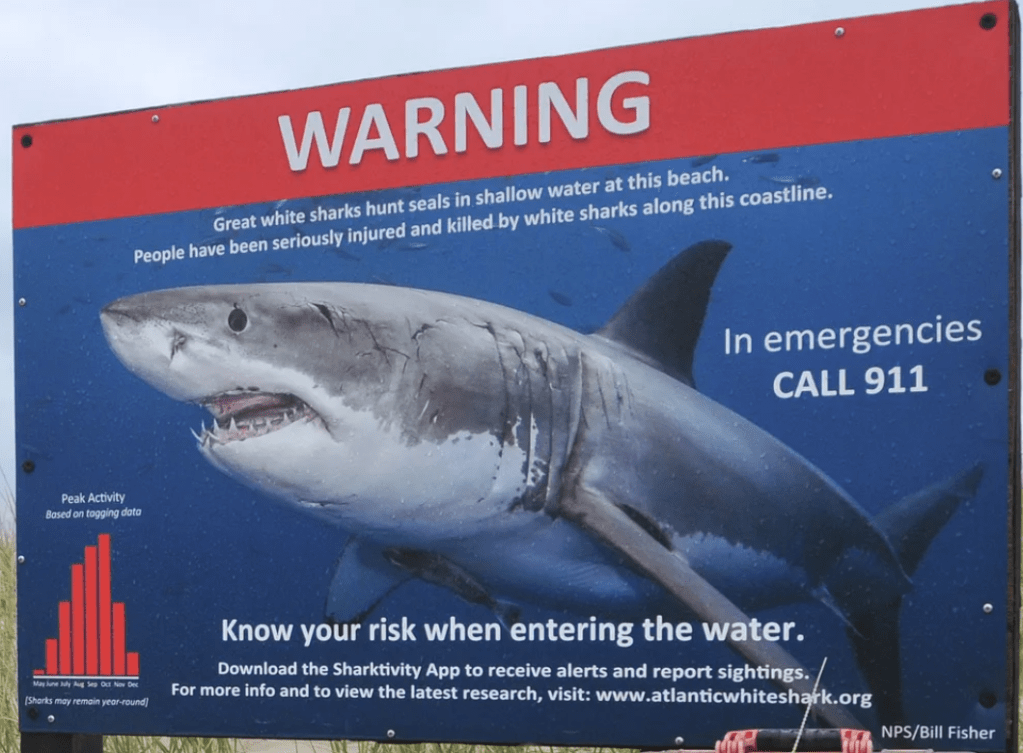
An informative “Be Shark Smart” sign at a beach in Cape Cod. USA. The Sharktivity App also gives people alerts and reports sightings of tagged sharks.
CLASS ACTIVITY – RESPECT SHARKS AND OCEAN LIFE!
Introduction
- Discuss the sharks’ seven senses, feeding habits, and basic ocean and beach safety.
- Invite a marine biologist, marine NGO, professional diver, etc. to talk about safety rules in the ocean and how to respect sharks in their natural habitat.
- Discuss the importance of accurate reporting with regards to fatal shark incidents. With students make a list of appropriate synonyms for “attack”.
- Activity
- Students choose a nearby beach or a popular holiday beach destination(Florida, Hawaii, Australia, Egypt, etc.) and research ocean facts and shark species.
- Students create a brochure/poster/PowerPoint or video presentation highlighting the safety rules to minimize fatal shark events. These can be specifically aimed at tourists, swimmers and surfers, or divers.
- Share your students’ work with other classes, parents, and the local community. You can also share with sailing clubs, surf schools the tourism board, and hotels. Additionally, consider lifeguards’ association, and local authorities.
RESOURCES:
VIDEO Rethink the Shark – AfriOceans Conservation Alliance (Lesley Rochat, 2011)
Shark Spotters– Safety Education Research Conservation
SharkSider.com user friendly site shares facts about all the amazing sharks
Sharks Around the World Find out which sharks are near you
Learn more about Sharks– Florida Museum
Happy World Environmental Education Day! (January 26th )
WWF has recently published a short manual in English: How to Prepare for a Trip in Nature
Ataques de Tubarão ou Incidentes?
“Turista morto em ataque de tubarão, “Surfista desaparecido morto em provável ataque de tubarão” ou “Tubarões assassinos” são títulos geralmente usados pela mídia para descrever incidentes envolvendo tubarões. Embora sejam realmente trágicos, esses não são “ataques” de tubarão. São incidentes fatais, encontros infelizes, avistamentos ou mordidas fatais. Eles devem ser corretamente relatados. “Ataque”, usado como substantivo, é definido como “um ato agressivo e violento contra uma pessoa ou lugar”, o que imediatamente rotula o tubarão como um vilão ou animal sedento de sangue que caça intencionalmente pessoas e provoca danos. Essa descrição, claro, está incorreta, pois os incidentes são não provocados. Portanto, devemos educar nossos alunos e colegas sobre como retratar com precisão os tubarões ao discutir sobre eles. Para garantir precisão, os jornalistas também devem contatar biólogos marinhos ou especialistas em tubarões antes de publicar qualquer notícia sobre encontros com tubarões. Afinal, os tubarões são animais selvagens. Eles viveram e se alimentaram em seu habitat natural—o oceano—nos últimos 450 milhões de anos.”Apresentação na seesão da SEI Portugal
Felipe Lamarca é um biólogo marinho brasileiro que se especializa na proteção dos tubarões. Ele visa mudar a visão das pessoas sobre os tubarões como predadores essenciais no topo da cadeia alimentar. Felipe informa regularmente sobre tubarões e suas curiosidades por meio das redes sociais, vídeos e cursos online. Recentemente, sua apresentação “Incidentes com Tubarões no Oceano” nas sessões online mensais do SEI (Segunda 2a feira) destacou alternativas para a palavra “ataque”, o aumento dos incidentes com tubarões e dicas de segurança. O aumento da população humana, o tempo que os surfistas e nadadores passam na água (em média 4 horas) e o uso de novas tecnologias nos últimos anos permitem que as pessoas estejam em contato mais próximo com a natureza, aumentando o risco de encontros fatais.
Lamarca continuou a explicar como os tubarões caçam suas presas. Os tubarões costumam circular em torno de suas vítimas para confundi-las. No entanto, eles também podem se aproximar repentinamente ou, às vezes, “esgueirar-se” por trás, especialmente em torno de mergulhadores ou nadadores em águas mais profundas. Ataques repetidos são a norma, com múltiplas ou mordidas sustentadas resultantes de seus hábitos alimentares. Ele listou abaixo algumas dicas básicas essenciais de segurança para nadadores e mergulhadores. Essas são importantes para visitantes de praias e do oceano, bem como para salva-vidas de praias, turistas, hotéis, pescadores e a comunidade.
Dicas de Segurança
Então, como você pode minimizar a chance de ser mordido por um tubarão? Siga estas regras básicas:
- Nunca nade sozinho. Nadar em grupo é melhor, pois tubarões têm mais probabilidade de atacar indivíduos.
- Não deixe seu cão de estimação nadar nas águas. Seus movimentos rápidos se assemelham aos de uma presa ferida e atraem tubarões nas proximidades.
- Não nade muito longe da costa. Isso não apenas aumenta seu isolamento, mas a assistência também está mais longe!
- Evite estar na água ao amanhecer ou ao anoitecer. Os tubarões estão mais ativos e mais alertas nesse horário.
- Não entre na água com uma ferida aberta e sangrando; intensifique os sentidos olfativos afiados do tubarão.
- Usar joias brilhantes não é recomendado. O reflexo da luz se assemelha à cor de escamas de peixe e também atrai tubarões.
- Esteja ciente dos tubarões e cauteloso antes de mergulhar em águas profundas ao navegar ao largo da costa. Lembre-se, você está em território deles e no caminho deles!
Os mergulhadores também nunca devem mergulhar sozinhos e sempre devem estar com um guia experiente. Eles devem sempre estar alertas sobre o que está à sua frente e atrás deles e observar os movimentos corporais do tubarão. Movimentos erráticos da cauda são um sinal agressivo que indica a necessidade de nadar rapidamente para a superfície, tanto para trás quanto de forma constante. Empurrar o tubarão com uma câmera ou um mastro é um método eficaz. Os olhos e as brânquias também são sensíveis ao toque, mas o focinho não é tão eficaz e está próximo da boca, segundo especialistas em tubarões.
Fato rápido:As cobras, mosquitos e cães são responsáveis pela maioria das mortes humanas. O Arquivo de Ataques de Tubarão da Flórida confirma o baixo número de incidentes de tubarões não provocados desde 1812. No entanto, incidentes fatais com tubarões são o perigo natural mais temido pelos humanos, ainda mais do que furacões!
——————————————————————–
ATIVIDADE DE AULA – RESPEITE OS TUBARÕES E A VIDA OCEÂNICA!
Introdução
- Discutir os sete sentidos dos tubarões, hábitos alimentares e segurança básica no oceano e na praia.
- Discutir a importância de relatórios precisos em relação a incidentes fatais com tubarões. Fazer uma lista de sinônimos apropriados para “ataque”
- Convide um biólogo marinho, uma ONG marinha, um mergulhador profissional, etc., para falar sobre as regras de segurança no oceano e como respeitar os tubarões em seu habitat natural.
Atividade
- Os alunos escolhem uma praia próxima ou um popular destino de férias à beira-mar (Flórida, Havaí, Austrália, Egito, etc.) e pesquisam fatos sobre o oceano e espécies de tubarões.
- Os alunos criam um folheto/pôster/apresentação em PowerPoint ou vídeo destacando as regras de segurança para minimizar eventos fatais com tubarões. Estes podem ser especificamente direcionados a turistas, nadadores e surfistas, ou mergulhadores.
- Compartilhe o trabalho dos seus alunos com outras turmas, pais, comunidade local, clubes de vela, conselho de turismo, hotéis, associação de salva-vidas, escolas de surf e autoridades locais.
RESOURCES:
VIDEO Rethink the Shark – AfriOceans Conservation Alliance (Lesley Rochat, 2011)
SharkSider.com user friendly site shares facts about all the amazing sharks
Sharks Around the World Find out which sharks are near you
ANP WWF Portugal Tubarões e Raias
https://www.natureza-portugal.org/o_que_fazemos_222/oceanos/tubarao/
Happy World Environmental Education Day! (January 26th )
WWF has recently published a short manual in English: How to Prepare for a Trip in Nature

 Teachers4Sharks