
The Azores archipelago is situated in the Atlantic Ocean and is renowned for its diverse and vital ocean biodiversity, surrounding its nine islands. Recently, excellent news regarding ocean biodiversity protection has been reported. Two important initiatives have been launched around the Azores islands. There is also more information about the mysterious six-gill shark (Hexanchus griseus) found in greater depths of the ocean.
The September 2024 issue of National Geographic magazine titled: O Mar dos Açores, or The Deep Frontier describes an oceanographic campaign focused on research on the Azores islands. The OceanXplorer, an oceanographic research vessel equipped with cutting-edge technology, aims to explore marine depths below 1,000 meters and demystify the least explored habitat on Earth.
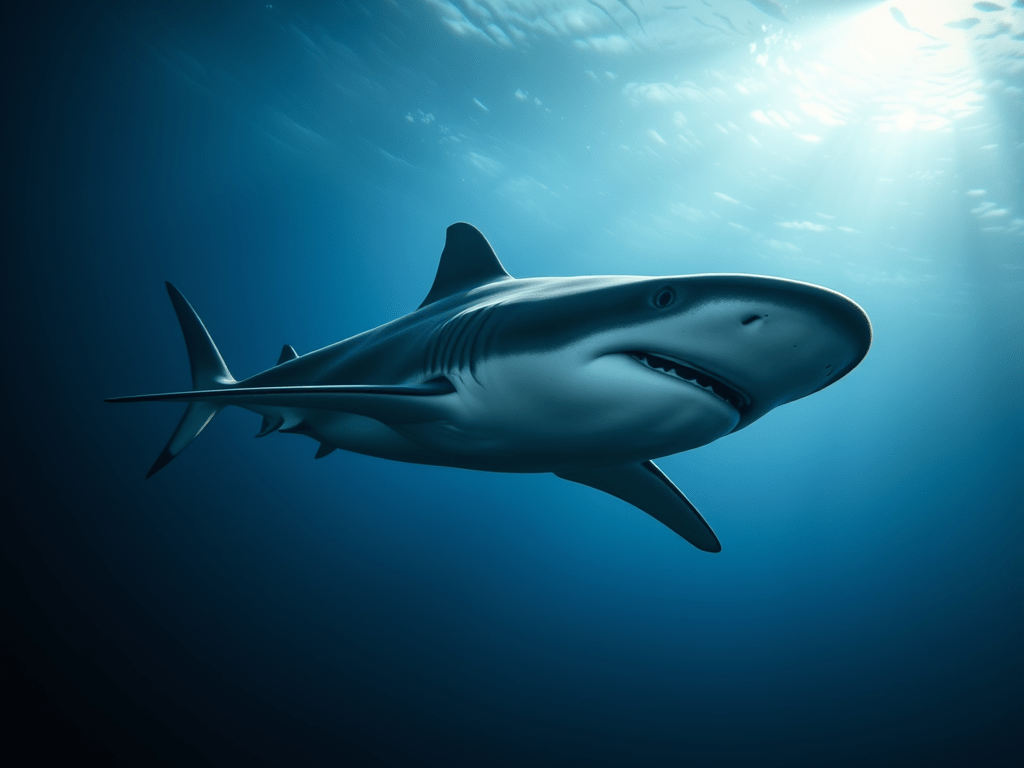
In June 2024, an international crew joined a special mission. The team included Jorge Fontes and Pedro Afonso from the University of the Azores. Their goal was to search, tag, and collect data on the Six-gill shark. This shark can grow up to 5.5 meters in length. It spends most of its time in the depths of the mesopelagic layer of the ocean, which is also known as the “twilight” zone, a region of more than 9,000 meters in depth. Here, the temperatures are about 4º C, and there is little daylight. Observations show that the Six-gill sharks do swim to shallower waters every night to feed along the underwater mountains. However, much of the sixgill shark’s behavior is still a mystery.
The crew of the small scientific submersible Neptune viewed eleven female and one juvenile six-gill sharks near the 250-meter-deep platform. After several attempts, Jorge F. was able to tag one of the sharks with a type of harpoon. This harpoon contained an arrow-like small box. It monitors the sharks’ speed, depth, and movements for about 12 hours. Then, it detaches and floats to the surface.
Bluntnose Six-gill Shark Spotted on Shipwreck – Canada. In June 2023, a diver was searching for shipwrecks. He was lucky to encounter and film the rarely seen blunt-nose six-gill shark on Vancouver Island, Canada.
LESSONS:
Shark of the Month– Every month, have your students research a different shark from different parts of the world. For example, this month, you can choose the six-gill shark. In groups, students can research 1-2 topics (habitat, diet, etc.) and learn more about this mysterious shark. The information collected can be put together as a book or an electronic slideshow (with music and voice). Share with the class, other students, and even the library!
The OceanXplorer and the Azores – with the assistance of the National Geographic magazine article above, students learn more about the oceanographic campaign. This includes the research vessel, its smaller submersibles, and the rich marine biodiversity located in the archipelago of the Azores. Underwater research is a vital and essential tool for gathering data and using this for scientific and educational purposes.
RESOURCES
KIDS National Geographic magazine
Personality quiz: Which shark are you?
Video: Sharks! Weird but True!
Children´s book: Show Me the Sea by João T. Tavares about underwater life around the Azores islands. Available in English and Portuguese (See July 23 Blog post)
- 3D Carribean Reef Shark – free for education use (Ocean X)
- Video: Canada- Bluntnose Sixgill Shark Spotted on Shipwreck
- Manta Catalog Açores
Ocean Xplorer Disney+ TV The six-episode series Ocean Xplorer is available on the Disney+ platform. The director, David Cameron, states, “Never has there been such an urgent need to understand the ocean and the animals that live there.”
AZORES ARCHIPELAGO PROTECTS THIRTY PERCENT OF WATERS
In October, the Autonomous Region of the Azores shared fantastic news a month before the COP 29 Climate Change conference in Azerbaijan. They would establish the largest network of marine protected areas (MPAs) in the North Atlantic. This historic move intends to protect 30% of the marine environment surrounding the Azores archipelago. The protection covering an incredible 287,000 square kilometers.
Congratulations to the government in addition to the universities, local schools, and communities who began their joint efforts in marine protection in the 1980s. The Blue Azores program, launched in 2019, has also contributed to significant advances in marine conservation in the region.
Oceanographer Dr. Sylvia Earle from Mission Blue states, “Bravo to the regional government and the citizens of the Azores for the creation of a new network of marine protected areas!” Mission Blue declared the Azores Archipelago a Hope Spot in 2021, advocating for a coherent network of marine protected areas extending from the surface to the deep seafloor.
MPAs, also known as marine parks, marine reserves, or marine conservation zones, are technically a section of the ocean where the government has placed limits on human activity. Although some established MPAs allow some form of environmentally friendly activity, others ban fishing. Several marine nongovernmental organizations are lobbying for No-take zones. These highly protected MPAs do not allow fishing, mining, drilling, or other extractive activities. One of the biggest challenges, however, is enforcing the laws and protecting MPAs from illegal fishing and other activities. Satellites and other technology will all be important tools to assist with the implementation process.
RESOURCES:
National Geographic The importance of MPAs
WWF Marine Protected Areas – Coral Triangle
Novas Iniciativas para a Conservação do Oceano nos Açores
O arquipélago dos Açores está situado no Oceano Atlântico e é conhecido por sua biodiversidade oceânica diversificada e vital, que envolve suas nove ilhas. Recentemente, excelentes notícias sobre a proteção da biodiversidade oceânica foram relatadas. Duas iniciativas importantes foram lançadas nas ilhas dos Açores. Há também mais informações sobre o misterioso tubarão-Albafares (Hexanchus griseus) encontrado em maiores profundidades do oceano.
A edição de setembro de 2024 da revista National Geographic intitulada: O Mar dos Açores focou em pesquisas nas ilhas dos Açores. O OceanXplorer, um navio de pesquisa oceanográfica equipado com tecnologia de ponta, tem como objetivo explorar as profundezas marinhas abaixo de 1.000 metros e desmistificar o habitat menos explorado da Terra.
Em junho de 2024, uma equipa internacional participou de uma missão especial. A equipa incluía Jorge Fontes e Pedro Afonso da Universidade dos Açores. O objetivo deles era procurar, marcar e coletar dados sobre o tubarão Albafares. Este tubarão pode crescer até 5,5 metros de comprimento. Ele passa a maior parte do seu tempo nas profundezas da camada mesopelágica do oceano. Esta camada é conhecida como a zona do “crepúsculo”. Os tubarões Alfabares nadam para águas mais rasas toda noite. Eles fazem isso em uma região de mais de 9.000 metros de profundidade. Aqui, as temperaturas são em torno de 4º C e há pouca luz diurna. Eles se alimentam perto de uma das montanhas submarinas açorianas. No entanto, muito do comportamento do tubarão Alfabares ainda é um mistério.
A tripulação do pequeno submersível científico Neptune visualizou onze tubarões-de-seis-guelras fêmeas perto da plataforma a 250 metros de profundidade. Após várias tentativas, Jorge F. conseguiu marcar um dos tubarões com um tipo de arpão. Este arpão continha uma pequena caixa em forma de seta. Ela monitorou a velocidade, profundidade e movimentos dos tubarões por 12 horas. Em seguida, se desvinculou e flutuou até a superfície.
Tubarão Albafares avistado em naufrágio – Canadá. Em junho de 2023, um mergulhador estava procurando por naufrágios. Ele teve a sorte de encontrar e filmar o raramente visto tubarão-de-seis-guelras de nariz rombo na Ilha de Vancouver, Canadá.
LIÇÕES:
Tubarão do Mês – Todo mês, peça aos seus alunos que pesquisem sobre um tubarão diferente. Por exemplo, neste mês, você pode escolher o tubarão Albafares. Em grupos, os alunos podem pesquisar de 1 a 2 tópicos (alimentação, habitat, etc.) e ensinar sobre esse misterioso tubarão. Reúna as informações e coloque-as juntas em um livro ou em uma apresentação eletrônica (com música e voz). Compartilhe com a turma, outros alunos e até mesmo a biblioteca!
O OceanXplorer e os Açores – Com a ajuda do artigo da revista National Geographic acima, os alunos aprendem mais sobre a campanha oceanográfica. Isso inclui o navio de pesquisa, seus submersíveis menores e a rica biodiversidade marinha localizada no arquipélago dos Açores. A pesquisa subaquática é uma ferramenta vital e essencial para a coleta de dados e para a utilização desses dados em propósitos científicos e educacionais.
RECURSOS
KIDS National Geographic magazine
Personality quiz: Which shark are you?
Video: Sharks! Weird but True!
Livro infantil: Mostre-me o Mar de João T. Tavares. Sobre a vida marinha ao redor das ilhas dos Açores. Disponível em inglês e português (Veja o Post do blog de 23 de julho).
- 3D Carribean Reef Shark – gratuito par fins educativos
- Video: Canada- Bluntnose Sixgill Shark Spotted on Shipwreck
- Manta Catalog Açores
- Ocean Xplorer Disney+ TV A série de seis episódios Ocean Xplorer está disponível na plataforma Disney+. O diretor, David Cameron, afirma: “Nunca houve uma necessidade tão urgente de entender o oceano e os animais que nele vivem.”
ARQUIPÉLAGO DOS AÇORES PROTEGE TRINTA POR CENTO DAS ÁGUAS
Em outubro, a Região Autônoma dos Açores compartilhou uma notícia fantástica um mês antes da conferência COP 29 sobre Mudança Climática no Azerbaijão. Eles estabeleciriam a maior rede de áreas marinhas protegidas (AMPs) no Atlântico Norte. Este movimento histórico tem como objetivo proteger 30% do ambiente marinho que cerca o arquipélago dos Açores. A proteção abrange impressionantes 287.000 quilômetros quadrados.
Parabéns ao governo, além de universidades, escolas locais e comunidades que começaram seus esforços conjuntos na proteção marinha na década de 1980. O programa Blue Azores, lançado em 2019, também contribuiu para avanços significativos na conservação marinha na região.
A oceanógrafa Dr. Sylvia Earle, da Mission Blue, afirma: “Bravo ao governo regional e aos cidadãos dos Açores pela criação de uma nova rede de áreas marinhas protegidas!” A Mission Blue declarou o Arquipélago dos Açores um Hope Spot em 2021, defendendo uma rede coerente de áreas marinhas protegidas que se estenda da superfície até o fundo do mar.
As AMPs, também conhecidas como parques marinhos, reservas marinhas ou zonas de conservação marinha. São tecnicamente uma seção do oceano onde o governo impôs limites à atividade humana. Embora algumas AMPs estabelecidas permitam alguma forma de atividade ambientalmente amigável, outras proíbem a pesca. Várias organizações não governamentais marinhas estão pressionando por Zonas de Não Pesca. Essas AMPs altamente protegidas não permitem pesca, mineração, perfuração ou outras atividades extrativas. Um dos maiores desafios, no entanto, é aplicar as leis e proteger as AMPs da pesca ilegal e de outras atividades. Satélites e outras tecnologias serão ferramentas importantes para ajudar no processo de implementação.
RECURSOS:
National Geographic The importance of MPAs
WWF Marine Protected Areas – Coral Triangle
 Teachers4Sharks